
Ships within 2 days via
We deliver to your doorstep under DAP terms. Customs clearance is for your account
Business customers can apply for Net 30
No fees, No interest, Fast approval.
Payment
| Item | Air Regulator |
|---|---|
| Adjustment Knob | Nonrising Dial |
| Adjustment Mechanism | Nonrising |
| Adjustment Range | 0 psi to 160 psi |
| Adjustment Range - Regulators | 0 psi to 160 psi |
| Air Inlet Gender | Female |
| Air Inlet Size | 1/2" |
| Air Outlet Gender | Female |
| Air Outlet Size | 1/2" |
| Air Outlet Type | NPT |
| Body Material | Aluminum, Zinc |
| For Fluid Type | Air |
| For Substance Type | Air |
| Max. Flow Rate | 195 CFM |
| Max. Pressure | 300 psi |
| Max. Temp. | 150°F |
| Maximum Operating Pressure | 300 psi |
| Minimum Operating Temperature | 32°F |
|---|---|
| Number Of Air Inlets | 0.5 |
| Number Of Air Outlets | 0.5 |
| Overall Depth | 3 3/16" |
| Overall Height | 4 1/16" |
| Overall Width | 2 3/16" |
| Overall Width - Regulators | 2 3/5" |
| Pipe Size - Regulators | 1/2" |
| Pressure Gauge Included | No |
| Pressure Gauge Port Size | 1/4" |
| Pressure Gauge Port Type | NPT |
| Regulator Type | Relieving |
| Seal Material | Nitrile |
| Series | R21 Series |
| System Location | Air Line |
| Valve Design | Balanced |
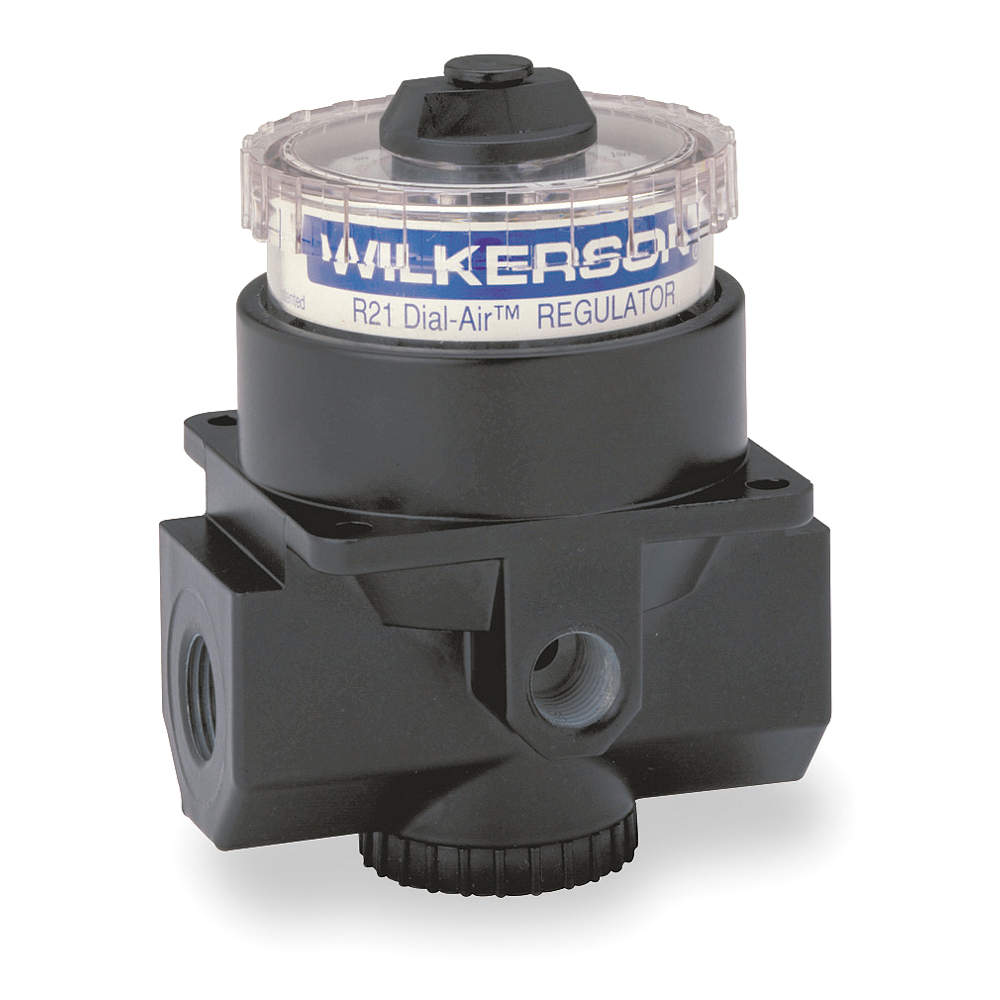
Wilkerson R21-04-000 air regulator is used to control and regulate the pressure of compressed air in pneumatic systems. It is an essential component in the manufacturing, automation and construction industries.
| Height (cm) | 10.32 |
|---|---|
| Length (cm) | 8.1 |
| Width (cm) | 5.56 |
| HS Code | 8481100060 |
|---|---|
| Country Of Origin | US |
| Weight (kg) | 1.0125 |
Regular maintenance involves checking for air leaks, inspecting & cleaning the regulator components and ensuring proper lubrication if required. Troubleshooting includes addressing pressure inconsistencies, excessive vibration or irregular operation.
A relieving air regulator releases excess pressure downstream when the set pressure is exceeded. It includes a relief valve or vents to relieve the excess pressure. On the other hand, a non-relieving air regulator does not release excess pressure and maintains a closed system when the set pressure is exceeded.
To ensure accurate pressure readings, install the pressure gauge or pressure sensor at a location downstream of the air regulator. Placing it before any restrictions, filters or other components can provide a more accurate reading of the regulated pressure.
A single-stage air regulator operates with a single pressure reduction stage, directly reducing the inlet pressure to the desired set pressure. In contrast, a two-stage air regulator has two pressure reduction stages. The first stage reduces the pressure to an intermediate level and the second stage further reduces it to the final desired set pressure. Two-stage regulators are used when precise control and regulation of the downstream pressure are required.

| Style | Model | Body Material | Air Inlet Size | Max. Flow Rate | Overall Width | Max. Operating Pressure | Air Outlet Size | Overall Depth | Seal Material | Price (ex. VAT) | Cart |
|---|---|---|---|---|---|---|---|---|---|---|---|
| A | R21-02-000 | Zinc | 1/4" | 117 CFM | 2 3/16" | 300 psi | 1/4" | 3 3/16" | Nitrile | $276.90 | |
| A | R21-03-000 | Aluminum, Zinc | 3/8" | 180 CFM | 2 3/16" | 300 psi | 3/8" | 3 3/16" | Nitrile | $276.90 | |
| B | R21-03-R00 | Aluminum, Zinc | 3/8" | 180 SCFM | 2 5/8" | 300 psig | 3/8" | 2 11/16" | Nitrile Rubber | $623.96 | |
| A | R21-06-000 | Aluminum, Zinc | 3/4" | 220 CFM | 2 3/16" | - | 3/4" | 3 3/16" | Nitrile | $276.90 |

Since you're visiting from the United States, for the best experience and tailored product searches, please use our dedicated U.S. website.
Go to ChatMRO.com (US)

 ChatMRO